
WELCOME BONUS 300%
UP TO €2000 + 100
FREE SPINS
UP TO €2000 + 100
FREE SPINS
Home → Roulette
Roulette at Spinz Casino
D'Alembert and Fibonacci Against the Same Table Limit
The D'Alembert system, which involves increasing bets after a loss and decreasing after a win, is tested against the Fibonacci sequence at tables with a maximum bet of €5,000. The Fibonacci strategy escalates bets more aggressively after a loss. Both systems aim to recover losses and achieve small profits over time, but their performance is inherently limited by the table's maximum wager.
European Roulette, with a house edge of 2.70%, presents a statistical challenge for any betting progression system. For instance, a €1,000 bet on an even-money outcome would yield €1,000 profit if won, but a string of losses quickly approaches the €5,000 table limit. This limit prevents unlimited recovery, a critical flaw in such strategies.
Players employing these systems must be aware that the theoretical advantage of the casino remains constant. Even with a 1:1 payout on even chances, a 2.70% house edge means that for every €100 wagered on such bets, €2.70 is expected to be retained by the casino in the long run. This fundamental aspect dictates the ultimate outcome regardless of the betting pattern.
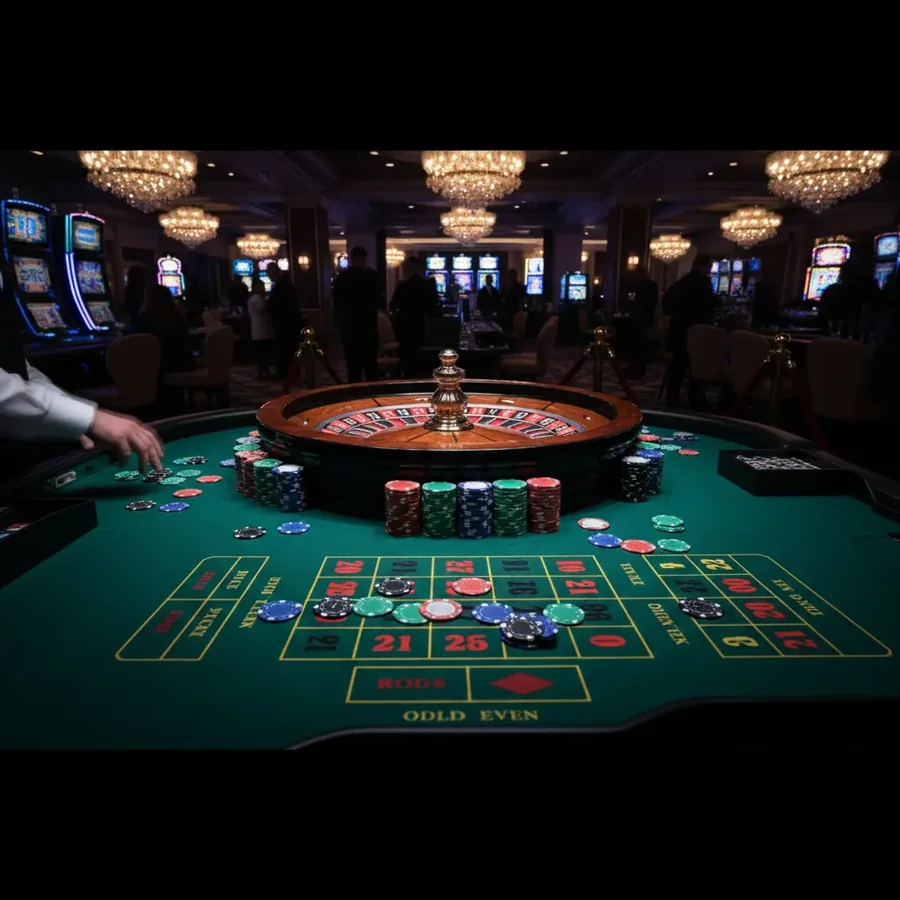
2.70 vs 5.26 Percent House Edge
The distinction between European Roulette's 2.70% house edge and American Roulette's 5.26% is significant for high rollers. European Roulette features 37 sectors (1-36 plus a single zero), offering better odds to the player. American Roulette adds a '00' sector, increasing the total to 38, thereby doubling the casino's inherent advantage on all bets.
This difference directly impacts potential long-term returns. For a €1,000 stake on an even-money bet in European Roulette, the expected loss over time is €27. In contrast, the same €1,000 stake on an even-money bet in American Roulette carries an expected loss of €52.60. This is a crucial consideration for players placing substantial wagers.
High rollers seeking to maximize their playing time and minimize the casino's edge should prioritize European Roulette tables. Even standard bets like a Straight bet at 35:1 are subject to the underlying house edge. The presence of the single zero in European Roulette fundamentally alters the mathematical landscape compared to the double zero found on American wheels.
Why the Ball Has No Memory
The spinning roulette wheel and the ball operate on principles of physics, not probability recall. Each spin is an independent event, meaning the outcome of previous spins has absolutely no bearing on future results. This is a fundamental concept often misunderstood by players employing betting systems.
For example, if red has landed ten times in a row on a European wheel, the probability of black hitting on the eleventh spin remains precisely 18 out of 37 sectors, or approximately 48.65%. The ball does not 'remember' the previous outcomes, nor does it 'try' to balance the results.
This statistical independence is why progressive betting systems can eventually fail. A player might chase a particular outcome, increasing their bet size with each loss, but the underlying probability for each individual spin remains constant. The house edge, a persistent factor, ultimately dictates the long-term outcome regardless of the ball's perceived tendencies.
Error: 10 Percent Contribution to Wagering Missed
The welcome bonus of 300% up to €2,000 plus 100 free spins requires careful consideration of wagering contributions. Table games, including roulette, typically contribute only 10% towards fulfilling these wagering requirements. This means that a €100 bet on roulette would only count as €10 towards clearing the bonus.
For a high roller aiming to clear the maximum €2,000 bonus, which would require a €4,000 stake if the wagering was 1:1, the 10% contribution significantly inflates the actual amount needed. If the wagering requirement is, for example, 40 times the bonus amount, a €2,000 bonus would normally require €80,000 in turnover.
With table games contributing only 10%, a player would effectively need to wager €800,000 in roulette bets to clear that same €2,000 bonus. This dramatically increases the playing time and risk involved. Players should always verify the specific game contributions to understand the true cost of bonus wagering.
French with La Partage vs European
French Roulette with the La Partage rule offers a reduced house edge of 1.35% on even-money bets, compared to European Roulette's standard 2.70% house edge. This rule applies specifically when the ball lands on zero, refunding half of the player's stake on outside bets such as Red/Black, Odd/Even, or High/Low.
The impact of La Partage is substantial for high rollers who frequently place even-money bets. A €1,000 bet on red in French Roulette with La Partage would result in a €500 refund if zero hits, effectively mitigating the loss. In contrast, European Roulette would result in the full €1,000 bet being lost.
While French Roulette with La Partage provides a superior edge on these specific bets, it is important to note that inner bets, such as a Straight bet at 35:1, do not benefit from this rule and retain the standard European Roulette house edge of 2.70%. Therefore, strategic play should leverage La Partage where applicable.
Roulette bet types at a glance
| Bet | Payout | Win Chance | Numbers Covered | House Edge |
|---|---|---|---|---|
| Roulette Französisch mit La Partage (gerade Chancen) | Rot/Schwarz 1:1 (bei 0 Rückerstattung 50%), Odd/Even 1:1, Low/High 1:1; Innere Einsätze ohne La Partage: Straight 35:1, Split 17:1, Street 11:1, Corner 8:1 | 98.65% | Bei 0 wird die Hälfte des Einsatzes auf gerade Chancen zurückerstattet (Rot/Schwarz, Pair/Impair, Manque/Passe). En Prison gibt denselben 1,35%. Regel gilt NUR für gleiche Einsätze | 1.35% |
| Roulette Amerikanisch (doppelte Null, 38 Sektoren) | Straight 35:1, Split 17:1, Street 11:1, Corner 8:1, Six Line 5:1, Dozen 2:1, Column 2:1, Rot/Schwarz 1:1 | 94.74% | 38 Sektoren (1–36 + 0 + 00); Auszahlungen wie beim europäischen Rad, aber der zusätzliche Sektor verdoppelt den Hausvorteil | 5.26% |
| Roulette Französisch, innere Einsätze (La Partage gilt nicht) | Straight 35:1, Split 17:1, Street 11:1, Corner 8:1, Six Line 5:1, Dozen 2:1, Column 2:1 | 97.30% | Rad gleich (37 Sektoren), aber La Partage/En Prison gilt nicht für innere Einsätze – Edge bleibt europäisch | 2.70% |
| Roulette Amerikanisch – Five Number Bet (0, 00, 1, 2, 3) | Five Number 6:1 (deckt 5 von 38 Sektoren) | 92.11% | Einzige Wette am amerikanischen Rad mit Edge über 5,26% – „Fallenwette“. Kein Äquivalent am europäischen Rad | 7.89% |
| Roulette Europäisch (einfache Null, 37 Sektoren) | Straight 35:1, Split 17:1, Street 11:1, Corner 8:1, Six Line 5:1, Dozen 2:1, Column 2:1, Rot/Schwarz 1:1, Odd/Even 1:1, 1-18/19-36 1:1 | 97.30% | 37 Sektoren (1–36 + 0); Auszahlungen wie für 36 Sektoren – daher konstanter Edge auf ALLE Wetten | 2.70% |
How Long a Session May Last
Roulette sessions are influenced by the speed of the game, with live dealer tables typically offering a slower pace. For instance, Ultimate Roulette allows bets from €0.10 to €5,000, with multipliers up to 1,000x, suggesting a focus on strategic play rather than rapid turnover. The average RTP for Ultimate Roulette is stated as 97.30%.
In contrast, RNG-based tables can offer a significantly higher number of rounds per hour. European Roulette, with its 37 pockets and a 2.70% house edge, might facilitate quicker gameplay compared to live variants. The payout for a straight bet remains consistent at 35:1 across many table types, including European Roulette. A session duration is therefore highly variable based on player decisions and game type.
The theoretical RTP of 97.30% applies to many roulette variants, including Mega Roulette and XXXtreme Lightning Roulette, indicating a consistent return over extended play. However, the specific betting limits, such as the €2,000 maximum bet on Mega Roulette, can influence how quickly a high roller might reach their session goals or budget.
Error: Using Opposite Bets for Wagering Fulfillment
Wagering requirements, such as the 300% welcome bonus up to €2,000, are subject to specific game contributions. Table games, including roulette, typically contribute only 10% towards fulfilling these requirements. This means that for every €100 wagered on a table game, only €10 counts towards the overall turnover. For example, to wager a €2,000 bonus at a 40x rate, a total of €80,000 in valid bets is required.
When fulfilling wagering requirements, placing opposite bets, such as betting on red and black simultaneously on a roulette table, is often considered a loophole and may not count towards the turnover. While European Roulette has a 2.70% house edge on all bets, these specific betting patterns might be excluded by the casino's terms and conditions. Players should always verify the specific rules regarding bet types.
The consequence of using strategies like opposite bets for wagering can result in the bonus funds and any associated winnings being forfeited. For a €2,000 bonus with a 40x wagering requirement, this would necessitate €80,000 in valid wagers. If such bets are deemed invalid, the player may find themselves unable to withdraw any winnings derived from the bonus.
Only 10 Percent Contribution: What are the Consequences?
The 10% contribution rate for table games towards wagering requirements means that high rollers must place significantly more bets to clear their bonus. A €2,000 welcome bonus requires €80,000 in turnover at a 40x rate. With a 10% contribution, this translates to €800,000 being wagered on table games to meet the requirement. This is a substantial amount even for high-stakes players.
For example, if a player consistently bets €100 per spin on a European Roulette table (RTP 97.30%, house edge 2.70%), only €10 of that wager will count towards the €80,000 total turnover needed. This means approximately 8,000 such spins would be required to fulfill the wagering, assuming no losses or wins significantly alter the bankroll.
This low contribution rate effectively extends the time and volume of play required to unlock bonus funds and winnings. Players aiming to utilize the full €2,000 bonus via table games would need to engage in a much longer and potentially higher-risk play session than if they were playing slots, which typically have a 100% contribution.
37 Pockets vs. 38 Pockets: The Difference
The fundamental difference between European Roulette (37 pockets) and American Roulette (38 pockets) lies in the addition of a double zero (00) on the American wheel. This extra pocket increases the house edge significantly. European Roulette offers an RTP of 97.30% with a house edge of 2.70%, while American Roulette has an RTP of 94.74% and a substantial house edge of 5.26%.
For high rollers, this difference in house edge has a direct impact on long-term profitability. While the payout for a straight bet is 35:1 in both variants, the increased number of sectors on the American wheel means a higher probability of the ball landing on a zero or double zero. The Five Number Bet on American Roulette, covering 0, 00, 1, 2, and 3, has a particularly high RTP of 92.11% and a house edge of 7.89%.
Choosing a European Roulette variant, such as Roulette Französisch mit La Partage, offers further advantages. This variant provides an RTP of 98.65% and a house edge of 1.35% on even-money bets due to the La Partage rule, which refunds half the stake when a zero hits. This is considerably lower than the 5.26% house edge on a standard American Roulette wheel.
Live Table vs RNG Table: Rounds per Hour
Live dealer tables like Ultimate Roulette, with betting limits from €0.10 up to €5,000, generally offer a more deliberate pace. The interaction with the dealer and the physical spinning of the wheel contribute to a lower number of rounds per hour compared to RNG-based games. The RTP for Ultimate Roulette is 97.30%.
Random Number Generator (RNG) tables, such as European Roulette, allow for a much faster gameplay experience. Players can place bets and spin the wheel at their own speed, leading to a significantly higher number of rounds within an hour. For instance, a player could potentially complete hundreds of rounds on an RNG table in the time it takes to complete a dozen on a live table.
The implications for high rollers are twofold: live tables provide a more immersive and social experience, potentially aligning with a strategic approach to larger bets up to €5,000 per round on Ultimate Roulette. Conversely, RNG tables allow for rapid accumulation of wagers, which can be beneficial for meeting bonus wagering requirements more quickly, despite the absence of live interaction.
Error: Planning for 500x Multiplier as Standard
Ultimate Roulette offers multipliers up to 1,000x on specific bets, with a potential doubling to 2,000x. This live roulette variant from Ezugi allows stakes ranging from 0.10 EUR up to 5,000 EUR. Players should note the RTP of 97.30% on this game, which is standard for many roulette titles.
Mega Roulette, provided by Pragmatic Play Live, features multipliers up to 500x on its 'Mega Numbers'. The maximum stake for this game is set at 2,000 EUR, with a stated RTP of 97.30%. A straight-up bet in this game pays 29:1, differing from standard roulette payouts.
The standard payouts for straight-up bets across most roulette variants remain 35:1, as seen in European and American Roulette. The presence of enhanced multipliers in live dealer games, such as Ultimate Roulette and Mega Roulette, represents a deviation from traditional game structures. Players aiming for higher potential returns should consult the specific game rules for multiplier mechanics.
European or American: Which Wheel Pays Better
European Roulette operates with a single zero, resulting in 37 sectors and a house edge of 2.70%. This configuration offers a standard Return to Player (RTP) of 97.30%. The payouts remain consistent across all bet types, with a straight bet yielding 35:1.
American Roulette features an additional '00' sector, bringing the total to 38 sectors and increasing the house edge to 5.26%. Despite the same payout ratios as European Roulette, the extra sector significantly impacts the overall RTP, lowering it to 94.74%. The 'Five Number Bet' in American Roulette carries an even higher house advantage of 7.89%.
French Roulette with La Partage offers the most favourable odds for even-chance bets, with an RTP of 98.65% and a house edge of 1.35%. This rule applies only to even-chance bets when the ball lands on zero, refunding half the stake. For other bets, the house edge reverts to 2.70%, similar to European Roulette.
Check Table Limit Before First Progression Starts
Spinz Casino offers live roulette tables with varying maximum bet limits, such as Ultimate Roulette allowing stakes up to 5,000 EUR. This high limit is beneficial for players employing progression strategies that require larger stakes in later stages. The RTP for Ultimate Roulette is 97.30%.
XXXtreme Lightning Roulette from Evolution Gaming also accommodates high rollers, with a maximum bet of 5,000 EUR per round. This game provides multipliers up to 2,000x on straight-up bets, alongside standard payouts of 35:1. The game's RTP is 97.30%.
Mega Roulette, a live game by Pragmatic Play Live, has a maximum bet limit of 2,000 EUR. While lower than some other live options, this limit still supports moderate progression betting. The RTP remains 97.30%, and straight-up bets pay 29:1 in this variant.
36 Instead of 37: The Math Behind 35:1
The standard payout for a straight-up bet in European and French Roulette is 35:1, despite there being 37 numbered sectors on the wheel. This payout structure inherently creates a house edge of 2.70%, calculated as (37 - 35) / 37. This edge applies consistently to all bets.
The RTP for European Roulette stands at 97.30%, a direct consequence of the 35:1 payout on a 37-sector wheel. This means for every 100 EUR wagered over the long term, theoretically 97.30 EUR is returned to the player. All standard bets, including splits, streets, and corners, are adjusted proportionally.
Even with a 35:1 payout, players can find favourable conditions in French Roulette with La Partage. For even-chance bets (e.g., red/black, odd/even) when a zero appears, 50% of the stake is returned, effectively lowering the house edge to 1.35% for those specific wagers. The RTP for these bets rises to 98.65%.
When is it Worth Switching to French Roulette?
Switching to French Roulette is particularly advantageous when focusing on even-chance bets like red/black or odd/even. The 'La Partage' rule, which refunds half the stake on a zero outcome for these bets, reduces the house edge from 2.70% to 1.35%. This results in a higher RTP of 98.65% for those specific wagers.
For players who primarily place outside bets or 'even-chance' wagers, French Roulette offers a mathematically superior environment. The standard European wheel has 37 sectors, but the La Partage rule significantly enhances the player's position on these specific bet types. This makes it a strategic choice for players prioritizing lower house commissions.
If a player's strategy involves primarily inside bets, such as straight-up numbers or corners, the advantage of French Roulette's La Partage rule is negated. For these bets, French Roulette functions identically to European Roulette, with a house edge of 2.70% and an RTP of 97.30%. The 'En Prison' rule, an alternative to La Partage, offers a similar benefit but may require the bet to remain for the next spin.
Contact
Live - online chat
Banking









Providers












Spinz Casino 2026